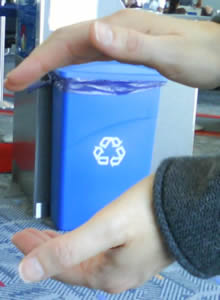
Most likely, if you were going to ask people what they, as individuals, could do to help care for creation, recycling would probably be among the top 5 answers they give.
Towns and municipalities have recycling programs because they reduce “tipping fees”. These are the fees that the town has to pay to dispose of a specific volume of waste at a landfill. In other words, the less you “toss”, the less you pay.
Recycling is part of the “3-R’s” of environmental care and is actually the “end of the chain”. I say end of the chain because if the first two of the “R’s” are done correctly, the 3rd “R” wouldn’t be needed.
The 3 R’s are:
- Reduce: reduce your use of items thereby reducing the amount of material you put into the waste stream.
- Reuse: reuse items so that they never go into the waste stream. Glass jars are a good example of a reusable item. Reusing an empty glass jar to store soup or other item makes sure that it never even goes out to the trash.
- Recycle: if you do have to dispose of something, by all means, try to recycle it (allow it to be turned into something else). This prevents the use of additional energy and materials required to manufacture a new item.
How To Recycle
There are no standards for what you can and can not recycle and how to recycle. In most cases, the exact how and why is left up to your city or town or to the company that actually picks up your trash.
The first thing that you should do if you are thinking about starting or improving a recycling program in your church is to contact the folks who faithfully come each week to collect your rubbish. If you don’t know who they are, you can either contact your town’s public works department or call the number that is on the front of the large trash bin that is emptied each week.
Ask whoever you talk to for a “recycling guide”. This will tell you things like:
- What materials can I recycle? Can I recycle paper, plastic, wood, cardboard and other materials.
- How do I have to package these materials? Does the cardboard have to be flattened or bundled? Can I recycle glossy paper (like magazines)?
- Do I have to separate recyclable materials or can they all be in one container? This is called ‘single stream’ recycling.
- How often will your recyclables be picked up? Is there a minimum or maximum amount of materials that can be disposed of at one time? This is important because you will have to arrange for adequate storage space between pick-up days.
Be aware that although you might be familiar with some of your town’s recycling rules for home trash, because your church may be considered a commercial business, the recycling rules and regulations might be different.
Plastics, Plastics, Plastics
Identifying things like paper and cardboard are pretty easy. Paper types that can be recycled are usually identified as “standard office paper” (the stuff you run through copy machines and fax machines) or “coated glossy” paper (typically found in magazines or brochures). Identifying cardboard is also pretty straight forward (although, for some reason, your refuse company might exclude pizza boxes or imported cardboard from the items it takes as recyclables. The exclusion of pizza boxes might be something worth considering next time you have a youth group pizza event!)
Plastics are a bit more of a challenge. To help consumers identify what plastics can be recycled (and also what plastics to purchase), the American Chemistry Council developed a resin identification coding system. This coding system are the small numbers surrounded by the familiar recycling arrows that appear on the bottom of most plastic containers. Your hauler will most likely have a list of what they will or will not take as recyclables. Items on this list will be identified by the resin identification coding system.
Here’s a brief description of what these codes mean (1) and an indication of what things you should be rescuing from the trash stream so that they can be recycled:
- Recycle Code 1 (PET): PET or PETE stands for Polyethylene Terephthalate. It is usually found in items such as:
- Plastic bottles for soft drinks, water, juice, sports drinks, beer, mouthwash, catsup and salad dressing.
- Food jars for peanut butter, jelly, jam and pickles.
- Ovenable film and microwavable food trays.
- Recycle Code 2 (HDPE): High Density Polyethylene (HDPE) is used in
- Bottles for milk, water, juice, cosmetics, shampoo, dish and laundry detergents, and household cleaners.
- Bags for groceries and retail purchases
- Cereal box liners
- Reusable shipping containers.
- Recycle Code 3: Polyvinyl Chloride (PVC, Vinyl). This material is used in:
- Blister packs and clamshells.
- Bags for bedding and medical, shrink wrap, deli and meat wrap and tamper resistance packaging.
- In addition to packaging, PVC’s major uses are rigid applications such as pipe, siding, window frames, fencing, decking and railing.
- Recycle Code 4: Low Density Polyethylene (LDPE). LDPE is found in:
- Bags for dry cleaning, newspapers, bread, frozen foods, fresh produce, and household garbage.
- Shrink wrap and stretch film.
- Coatings for paper milk cartons and hot and cold beverage cups.
- Container lids.
- Toys.
- Squeezable bottles (e.g., honey and mustard).
- Recycle Code 5: Polypropylene (PP). Polypropylene is used to make:
- Containers for yogurt, margarine, takeout meals, and deli foods.
- Medicine bottles.
- Bottle caps and closures.
- Bottles for catsup and syrup.
- Recycle Code 6: Polystyrene (PS). PS is used for:
- Food service items, such as cups, plates, bowls, cutlery, hinged takeout containers (clamshells), meat and poultry trays, and rigid food containers (e.g., yogurt). These items may be made with foamed or non-foamed PS.
- Protective foam packaging for furniture, electronics and other delicate items.
- Packing peanuts, known as “loose fill.”
- Compact disc cases and aspirin bottles.
- Recycle Code 7: This code is used to indicate that the item is made of resin but is not one of the types listed above. It is typically found on:
- Three- and five-gallon reusable water bottles,
- Some citrus juice and catsup bottles.
- Oven-baking bags, barrier layers, and custom packaging.
A couple of other things to note:
- Some states have deposit rules on bottles and aluminum beverage cans. If your state has these laws, by all means collect and return these bottles for the deposits. The beverage companies take responsibility for recycling items like these.
- Check with your refuse hauler or town to see about things like cans (the type you have to open with a can opener).
One final piece of advice. If you can’t recycle it, then don’t buy it. Following this advice might require you to be a bit more selective on what it is you purchase and might require you to shop a bit harder for your next church-wide function or your office supplies but in the end, caring for His creation by reducing the number of things we throw into our landfills is well worth it!
Notes:
[1) This list is from the American Chemistry Council. It is on the web at:
http://www.americanchemistry.com/s_plastics/doc.asp?CID=1102&DID=4644