Face it… in the USA and many other parts of the world, we love our cars. We have grown into a car addicted society. There are many reasons for this not the least of which are the way that our neighborhoods are built. In many suburbs, where we shop, where we work and where we worship may be far away from where we live.
Very often, the amount of parking a building is required to have is dictated by local zoning ordinances. These ordinances (which sometimes specify 1 space for every 4 people that the building is designed to hold) make it not so unusual to see buildings where parking areas take up more space than the buildings they are designed to serve.
So, this makes parking a key consideration when designing or expanding a worship facility.
At most churches, when building or remodeling, it might not be very productive (or possible) to attempt to change these zoning laws. In addition, since cost is a factor, the “flatten and pave” method – a technique that meets zoning requirements and is cost efficient – is often used.
Sometimes, cost efficiency and creation care don’t go hand-in-hand. The flatten and pave method when it is used without considering creation, has its problems — not the least of which is the production of “urban runoff” from rain or melting snow.
Without going into too many details, “urban runoff” is caused by the amount of runoff and speed of runoff produced by the parking lot. Effects from ubran runoff include erosion, stream and wildlife damage due to higher temperature runoff channeled into streams and the rapid flush of pollutants (gasoline, oil, heavy metals and other chemicals) into the stormwater system that occurs after the first good rain of the season.
What these problems have in common is that they are caused by the impervious material used to build parking lots. Using impervious material prevents rain water from being returned to the ground where it is filtered and where it replenishes the water table. Focusing on reducing the problem of urban runoff is one great way reduce the environmental impact of your parking lot
Here are some suggestions about how your parking lot and God’s creation can work better together:
Choose a “Groundwater Friendly” Material for Parking Surfaces
First, consider the surface itself and how much your lot is used. Consider that, In many churches, the lot is filled to capacity only for Sunday services and for the remainder of the week, the lot is only partially full and used by the staff or for the people who are attending other activities.
With this in mind, consider if it is necessary to have the entire area covered by blacktop or concrete (which is impervious) or is a better option to build a lot where the most used area (used for the staff, daily visitors and weekday events) is blacktop and the least used areas (overflow parking used during worship times) are covered with grass or porous pavers?
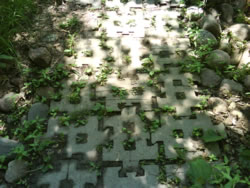
Porous pavers used as part of a walkway
(You might also want to consider further reducing runoff by building walkways out of porus materials — especially those that are not heavily used).
Change Where The Water Is Collected
Runoff from storms has long been a problem for cities as more and more areas are paved with impervious materials. As more and more of our cities get paved, the water that hits them has to be channeled somewhere — either into storm drains or sewer systems. Either way, this causes stress on the capacity of these systems. (In an ideal world, you want to move the water as little as possible before it gets to a place that it can soak back into the ground.
More recently, building codes require that water be collected and held in a “retention pond”. These retention ponds (the size of which are dictated by the amount of impervious area such as parking lots and roofs your building has) are designed to capture and hold rainwater before it is absorbed into the ground.
Retention ponds can be either a benefit or a blight depending on how you see them. If you consider a retention pond as a created resource that can attract wildlife such as birds and encourage nature such as native plants and flowers then it can become an asset to your building by acting as an “outdoor laboratory” where practical creation care techniques can be demonstrated and enjoyed.
Churches with retention ponds on their property have turned them into bird preservation areas or peaceful places with trees, benches and water that provide rest and prayer areas. Some churches have also restored the retention area to natural prairie or forest landscaping to help people understand what unspoiled creation can look like.
Let the Parking and Gardens Work Together
If you don’t have a retention pond, there are alternatives that involve either channeling or storing the water for other uses — the most obvious being landscape care.
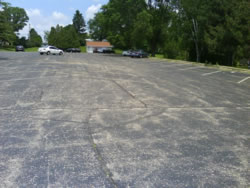
This parking lot...
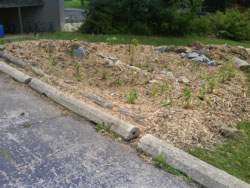
drains to this newly planted rain garden instead of a storm drain.
One use that comes to mind is to make the parking lot and landscape work together through the use of rain gardens. A rain garden is a depression, (either one you create or one that is natural) where water from impervious areas such as roofs, parking lots, compacted grass areas or pathways is channeled.
The rain garden is filled with native plants that act to filter pollutants from that water before it soaks through layers of the earth to re-enter the groundwater system. These rain gardens also add to the humidity of the environment by returning water directly to the atmosphere . Native plants and flowers are usually used in rain gardens because they are drought tolerant, don’t require fertilizer and are adapted to the natural rain / dry cycles of the area. Native plants also typically require less care than other plants.
A great way to identify suitable areas for rain gardens is by watching where water collects around your building after a heavy rainstorm. Areas that remain muddy in between storms, show signs of erosion or are constantly too wet to use are perfect candidates for rain gardens.
Other Ideas
Some other ideas that can help your parking lot more gently integrate with the environment.
- Consider the use of curb cuts and other items in the lot that allow water to flow directly from the lots into gardens. The city of Los Angeles has successfully experimented with curb cuts as a way to control water runoff. How they are doing it is described here.
- Incorporate landscaped islands or strips between parking spaces into your parking lot. Landscape these islands with trees and native plants. If you have concrete wheel stops in your lot, raise them up so that runoff water can pass under them into these islands or strips. These “green islands” help prevent “heat islands” which raise the air temperature in urban areas. They also provide shade for parked cars and provide bird habitat.
- Add landscaped buffer areas at the perimeter of the lot. These areas, planted with grass or filled with sand can be used to slow runoff and allow it to be filtered into the ground.
- Use rain barrels to collect water for gardens as another way to reduce runoff. Rainbarrels are especially helpful to collect water for gardens in courtyards or at entrances to buildings.
- If you are looking at building a new building or moving to a new building consider a location with shared parking. For example, locating a church in a business area that has heavy parking needs during the week but very little or no parking needs on the weekends may allow parking to be shared. Sharing an existing space is a good solution because a parking area that is not built is one that benefits the environment the most.
- Reduce the amount of parking (or preventing expansion of existing parking) by encouraging alternative modes of transportation such as carpooling, walking or bicycling. Some ideas about how to do that are here.
All-in-all, even though we would like to see it, it’s not realistic that your building will have no parking at all. That would be great but as long as we have cars and zoning laws and some of our churches are located far away from where we live, parking will be a part of churches.
Hopefully these suggestions can help you and others in your church work so that parking lots and creation work a bit better together and so parking lots don’t do so much damage to God’s creation.